

Dieldrin in Guam Water: What Homeowners Should Know
Dieldrin is a legacy pesticide that can remain in soil and groundwater for many years. Here is what Guam homeowners should know about the issue, current treatment efforts, and residential water filtration options.
For most families in Guam, turning on the faucet is something we do without thinking.
But when news about a chemical such as dieldrin appears in the local water supply, homeowners naturally have questions:
The answers are important — but they should also be put into context.
Dieldrin is not a new chemical being added to Guam’s water today. It is a legacy pesticide that can remain in soil and groundwater for a long time.
Guam EPA and the Guam Waterworks Authority have been monitoring the issue, treating affected sources, and implementing additional filtration programs in areas where action has been required.
For homeowners, the key is to understand the problem, follow official water-quality guidance, and choose treatment equipment based on verified performance rather than fear.
What Is Dieldrin?
Dieldrin is a man-made pesticide that was widely used in the United States during the mid-20th century, including for insect and termite control.
According to Guam EPA, dieldrin was used as an insecticide from the 1950s until 1987. It is also a breakdown product of another pesticide called aldrin.
The important characteristic of dieldrin is persistence.
That is why it is often described as a “legacy contaminant.” Even though the chemical has not been produced or used in the same way for decades, residues from historical use can remain in the environment.
Guam EPA’s May 2026 Risk Assessment Document states that dieldrin continues to be detected in Guam drinking-water sources and establishes an Interim Action Level, or IAL, of 0.20 micrograms per liter (µg/L), also expressed as 0.20 parts per billion (ppb).
Why Did Dieldrin Become a Guam Water Issue?
Guam depends heavily on groundwater.
Water moves through the island’s soil and limestone formations before reaching the aquifer. If a persistent chemical remains in soil from historical pesticide or termite-control use, there is a possibility that it can migrate into groundwater over time.
The exact source of dieldrin found in Guam groundwater has not been definitively established.
GWA has stated that historical application around building foundations, disturbed soil from construction, and disposal of excavated material are among the possible pathways being considered.
These are explanations under investigation rather than confirmed sources.
This distinction is important: the presence of dieldrin does not mean that every home or every well in Guam has the same water-quality condition.
Is All of Guam’s Water Affected?
No. The issue has been concentrated in particular water sources and service areas.
The Santa Rosa/Yigo area received significant attention because of dieldrin levels associated with production well Y-15. GWA subsequently installed an interim granular activated carbon treatment system, followed by a permanent treatment system.
According to GWA’s September 4, 2026 mitigation update, the permanent GAC treatment system at Y-15 was placed online on August 25, 2026. GWA reported that the system uses two trains of GAC vessels in a lead-lag configuration to provide treatment redundancy and continues to undergo increased monitoring.
The same GWA update reported ongoing treatment work involving other wells and continued monitoring across the system.

Homeowners should rely on their specific service-area information and the latest official GWA and Guam EPA notices rather than assuming that one test result represents the entire island.
What Are the Health Concerns?
Guam EPA identifies dieldrin as a probable human carcinogen based on U.S. EPA assessments.
The concern is primarily about exposure above established advisory levels, especially over long periods.
Guam EPA’s current Interim Action Level is 0.20 ppb.
Its May 2026 guidance states that people should not drink or cook with water containing dieldrin above the IAL without appropriate treatment.
It also states that an exceedance above 0.50 ppb requires a higher-level public notification because that concentration exceeds the short-term, non-cancer health advisory level referenced in the agency’s risk assessment.
This does not mean that every detection creates the same level of risk. Concentration, duration of exposure, source water, treatment, and actual consumption all matter.
For personal health questions, homeowners should follow Guam EPA guidance or consult an appropriate healthcare professional rather than relying on general internet information.
Can Boiling Water Remove Dieldrin?
GWA specifically advises that boiling water does not remove dieldrin.
Boiling is useful for certain microbiological problems, but it is not a treatment method for this type of persistent organic chemical.
This is why the treatment technology matters.
How Can Dieldrin Be Reduced From Water?
Guam EPA and GWA identify granular activated carbon, or GAC, as an important treatment method for dieldrin.
Guam EPA also notes that approved drinking-water vending systems in Guam use both granular activated carbon and reverse osmosis treatment.
For homes, treatment generally falls into two categories:
Point of Use (POU)
A Point-of-Use system treats water at one location, such as a dedicated drinking-water faucet under the kitchen sink.
- Focused treatment at a specific faucet
- Commonly used for drinking water
- Can be paired with RO and other filtration technologies
- Typically treats a smaller volume of water
Point of Entry (POE)
A Point-of-Entry system treats water as it enters the property before it is distributed to faucets, showers, appliances, and other plumbing fixtures.
- Whole-house treatment approach
- Treats incoming water before distribution
- Can provide treatment throughout the residence
- Requires appropriate system sizing and maintenance
Why Would a Homeowner Choose Whole-House POE Filtration?
The biggest difference is coverage.
An under-sink drinking-water system protects only the water coming from that particular drinking-water outlet.
A properly designed POE system treats the incoming water supply before it is distributed throughout the home.
This can be important for families who want an additional treatment barrier for household water rather than only drinking water at the kitchen sink.
A whole-house system may also be easier for families who do not want to manage separate filters at multiple fixtures.
However, POE filtration is not a “one size fits all” product.
A professional assessment should consider:
A system that works properly in one house may not be correctly sized for another.
Certification and Maintenance Matter
Buying a large filter housing does not automatically mean the system is suitable for dieldrin treatment.
Guam EPA’s current guidance says that a home POE or POU device used for this purpose should include granular activated carbon and should be certified by an ANSI National Accreditation Board-accredited certification body to applicable NSF/ANSI 53 or 401 standards.
Homeowners should also confirm the manufacturer’s specific contaminant-reduction claims and follow the required operating conditions.
Filter replacement is especially important.
Carbon filters have a finite treatment capacity. Performance depends on water quality, total gallons processed, flow rate, contaminant loading, and the specific cartridge.
A professional maintenance schedule is as important as the original installation.
Water Doctor Guam and the GWA POE Response
The dieldrin response has not been only a discussion about water quality. It has also required actual work at individual homes.
GWA’s public mitigation updates identify SBS Guam as one of the contractors participating in the POE installation program. GWA reported that SBS Guam began POE installations on May 25, 2026.
By August 27, GWA reported a combined total of 304 completed POE installations through its participating contractors, with additional installations still pending at that time.
For Water Doctor Guam, that field experience is important.
A whole-house system is not simply a filter attached to a pipe. Every residence presents different plumbing conditions, mounting locations, available space, pressure conditions, and service-access requirements.
Our experience working with Guam homes allows us to evaluate these details before recommending a system.
Important Update for Yigo / Santa Rosa Homeowners
The situation has continued to change as treatment systems have been completed.
According to GWA’s September 4, 2026 update, the permanent GAC treatment system at production well Y-15 went online on August 25, 2026.
GWA’s POE application deadline was September 17, 2026.
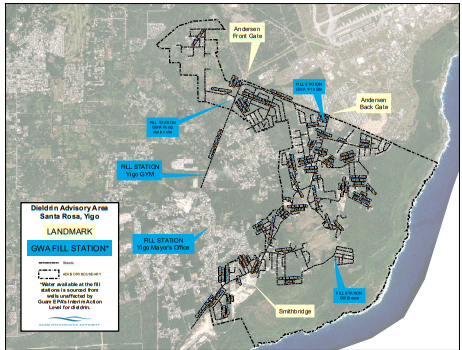
Because water-quality conditions, treatment status, and program eligibility can change, residents should always check the current GWA and Guam EPA information before making decisions based on older notices or social-media posts.
The Bottom Line
Dieldrin is a real water-quality issue that deserves careful monitoring and appropriate treatment — but it should also be understood accurately.
It is a persistent legacy pesticide, not a new chemical being intentionally introduced into Guam’s water.
The concern has involved specific sources and service areas rather than every water source on the island.
Guam EPA and GWA have responded with monitoring, source-water GAC treatment, public notification, and residential POE/POU programs.
For homeowners who want an additional treatment barrier at their property, a professionally designed whole-house Point-of-Entry filtration system can provide a practical option.
The system should be selected based on actual water conditions, certified treatment performance, household flow requirements, and a realistic maintenance plan.
Concerned About Your Home’s Water?
Water Doctor Guam can help you understand your home's water-treatment options and determine what type of filtration system may be appropriate for your property.
From whole-house POE filtration to drinking-water systems, our goal is to help Guam homeowners choose a treatment approach based on their actual water conditions and household needs.
Water Doctor Guam
WaterDoctor.us
Reference Links
-
Guam EPA – Dieldrin Information
View source -
Guam EPA – May 2026 Risk Assessment Document / Interim Action Level for Dieldrin
View source -
Guam Waterworks Authority – Guam Water Safety FAQ
View source -
Guam Waterworks Authority – Dieldrin Timeline
View source -
GWA – September 4, 2026 Dieldrin Mitigation Update
View source -
U.S. EPA – Dieldrin IRIS Summary
View source